Sunday, 24 May 2020

Figure 1 - Ants as a superorganism.

The transition from solitary to eusocial organisms has been likened to the transition from unicellular to multicellular life, that multicellularity and sociality represent two major and analogous evolutionary innovations. Both being examples of how individual elements, that is cells and individuals, can cooperate to enhance evolutionary fitness. This has led to eusocial insects being dubbed by some as 'superorganisms' (Figure 1).

The 'superorganism hypothesis' (Wilson, 1989) considers eusocial colonies as biological individuals because they act as a single, cohesive unit. That is, they are individuated and persist over time i.e. once colonies are formed they do not dissolve or merge with other colonies, (except in the case of some termites; Matasura and Nishida, 2001); they undergo development, as opposed to being formed by the aggregation of solitary insects; and most importantly, because of the reproductive division of labor, for some species the colony itself is the unit of reproduction (Wheeler, 1911). In this way, the society or insect colony becomes the extended phenotype of the collective genome of the society (Hölldobler and Wilson, 2005).

Another similar theory posits that there are economies of scale related to energy use such that cells in larger, more complex animals require less energy per capita. Eusocial species experience similar relationships with colony size, with evidence suggesting that these colonies are functionally organized and are using and expending energy for the basic processes of life in much the same way that individuals are (Hou et al., 2010).

While there is still contention as to the use of the term 'superorganism' (Boomsma and Gawne, 2018) and whether or not analysing these colonies as singular organisms is meaningful, the analogous transition from singular to eusocial with the evolution of multicellular life is undoubtedly an interesting phenomenon.


References:
Boomsma, J.J., Gawne, R., 2018, Superorganismality and caste differentiation as points of no return: how the major evolutionary transitions were lost in translation., Biological Reviews, 93, 28–54.

Hölldobler, B., Wilson, E., 2005, Eusociality: Origin and consequences., Proceedings of the National Academy of Sciences Sep 2005, 102 (38) 13367-13371; DOI: 10.1073/pnas.0505858102

Hou, C., Kaspari, M., Vander Zanden, H.B., Gillooly, J. F., 2010, Energetic basis of colonial living in social insects., Proceedings of the National Academy of Sciences of the United States of America, 107(8), 3634–3638. https://doi.org/10.1073/pnas.0908071107

Matsuura, K., Nishida, T., 2001, Colony fusion in a termite: What makes the society "open"?, Insectes Sociaux. 48. 378-383. 0.1007/PL00001795.

Wheeler, W. M., 1911, The ant-colony as an organism., J. Morphol. 22, 307–325. doi: 10.1002/jmor.1050220206

Wilson, D.S., Sober, E., 1989, Reviving the superorganism., J Theor Biol. 136:337–356


Figure:
The tiny and big, https://steemit.com/ants/@thegreatlife/the-tiny-and-big, 23/05/20

Wednesday, 20 May 2020


                Figure 1- Termite nest cross section                .

While the eusocial hymenoptera evolved from predatory wasps, termites instead evolved from wood-feeding cockroaches and form a sister group with the cockroach genus Cryptocercus (Lo et al., 2000). As discussed last week, the supersister relationship is thought be a driving factor in the evolution of eusocality in hymenoptera, but this genetic configuration is not present in termites. Instead nest inheritance is throught to be one of the main selective forces for the evolution of altruism and eventually the sterile worker castes (Miles, 1988).

The primitive habitat of termites was probably inside dead wood (logs, stumps, dead parts of living trees) in which the society found both food and shelter. This is a condition that seems to drive eusocial evolution, as it is also observed in vastly different species such as the marine sponge-dwelling shrimp who live and feed inside their sponge hosts (Duffy, 1996). This home and food source becomes a multi-generational asset, a source of direct fitness for these primitively eusocial insects (Leadbeater et al., 2011), one that promotes social interactions between its potentially highly related inhabitants.

Studies suggests that, in contrast to hymenoptera, brood care by termite workers is not necessary prerequisite for termite eusociality and the level of worker altruism seems to differ greatly between species (Korb et al., 2012). Brood care was shown to be low in wood-dwelling termites, suggesting that early social evolution in termites wasn’t driven by cooperative brood care but rather by the defensive benefits that a nest provides.

The degree of altruistic worker brood care seems to depend on environmental conditions, for example pathogen load appears to be a major factor in promoting altruistic allogrooming in workers (Korb et al., 2012), indicating that nest-level defence against pathogens may have been an additional driver of termite social evolution. 

Although the nest is a characteristic of all eusocial insects, among them termites are distinguished by the great diversity of their nests with sprawling and complex architecture (Figure 1). This diversification is related to the evolution of social life and the changing of food sources (Noirot, 2000). As termites evolved from living inside their food source towards becoming an foraging species, new challenges had to be met. Their relatively soft bodies had to adapt to new climates and so nests modified accordingly, with the establishment of architecture that provides a microclimate suitable for termite life (Woon et al, 2019) and a structure designed for the defense of the colony against predation. 


References:
Duffy, J., 1996, Eusociality in a coral-reef shrimp. Nature 381, 512–514 (1996). https://doi.org/10.1038/381512a0

Korb, J., Buschmann, M., Schafberg, S., Liebig, J., Bagnères, A., 2012, Brood care and social evolution in termites. Proceedings. Biological sciences / The Royal Society. 279. 2662-71. 10.1098/rspb.2011.2639.

Leadbeater, E., Carruthers, J., Green, J., Rosser, N., Field, J., 2011, Nest Inheritance Is the Missing Source of Direct Fitness in a Primitively Eusocial Insect. Science (New York, N.Y.). 333. 874-6. 10.1126/science.1205140. 

Lo, N.,  Tokuda, G.,  Watanabe, H.,  Rose, H.,  Slaytor, M.,  Maekawa, K.,  Bandi, C.,  Nodam H., 2000, Evidence from multiple gene sequences indicates that termites evolved from wood-feeding cockroaches, Curr Biol., 2000 , vol. 10 (pg. 801-804)

Myles T.G., 1988, Resource inheritance in social evolution from termite to man. In: Slobodchikoff CN, editor. Ecology of Social Behavior. New York: Academic Press; 1988. pp. 379–425.

Noirot C., Darlington J.P.E.C., 2000, Termite Nests: Architecture, Regulation and Defence. In: Abe T., Bignell D.E., Higashi M. (eds) Termites: Evolution, Sociality, Symbioses, Ecology. Springer, Dordrecht

Woon, J., Boyle, Michael, Ewers, R., Chung, A., Eggleton, P., 2018, Termite environmental tolerances are more linked to desiccation than temperature in modified tropical forests. Insectes Sociaux. 10.1007/s00040-018-0664-1.

Figure:
Cross-section image of a termite mound, https://www.earthlymission.com/take-a-look-inside-a-termite-mound/,  20/05/2020

Friday, 15 May 2020

       Figure 1 - Haplodiploid sex determination.            .

While esociality has evolved in different orders of animals, from mammals like the naked mole rat (Jarvis, 1981) to marine sponge-dwelling shrimp (Duffy, 1996), it has been most commonly observed in the order Hymenoptera (the sawflies, wasps, bees, and ants), where it has evolved at least eleven separate times (Wilson, 1975). This has been hypothsised to be due a result of the peculiar genetic arrangement present in the order, haplodiploidity.

Haplodiploidy is a sex-determination system where males develop from unfertilized eggs and are haploid (only a single set of chromosomes, similar to gametes like sperm or eggs), and females develop from fertilized eggs and are diploid (two sets of chromosomes). In this system males have no father, and females that have not mated will produce only male offspring (Figure 1). The evolutionary history of this peculiar adaptation is murky, but haplodiploidy seems to have evolved most commonly in insect species that nest in bark and are exposed to Wolbachia, a bacteria that infects the ovaries of insects (Kawasaki et al, 2016). 

Of particular evolutionary interest is how haplodiploidity effects the relatedness between family members. Due to this genetic configuration, a male’s sperm are all identical, and the offspring of his matings all bear the identical genetic contribution from their father. The relatedness among sisters is particularly noteworthy in lifetime monogamous haplodiploids, with sisters having an average relatedness of r = 0.75 (Hamilton, 1964). Dubbed 'supersister relatedness' in these haplodiploid species, sisters are more related to each other than to their mother, their daughters or to any other family member.

The haplodiploidity hypothesis (Hamilton, 1964) argues that haplodiploid inheritance generates relatedness asymmetries that promote the evolution of altruism by females, due to the high relatedness between sisters (via Hamilton's rule of kin selection). While the haplodiploid hypothesis has fallen from favour over the years, and although haplodiploidity is clearly not essential for the evolution of eusocialality, there is undoubtedly correlation with the likelihood of it occurring. Recent studies have shown that haplodiploid females should be more prone to altruism than diplodiploid females (Kennedy and Radford, 2020), strengthening the idea that the an altruistic social structure is a more likely evolutionary outcome when you have high relatedness like these supersisters.


References: 
Duffy, J., 1996, Eusociality in a coral-reef shrimp. Nature 381, 512–514 (1996). https://doi.org/10.1038/381512a0

Hamilton W.D., 1964, The genetical evolution of social behaviour. II. J Theor Biol. Jul;7(1) 17-52. doi:10.1016/0022-5193(64)90039-6. PMID: 5875340.

Jarvis, J., 1981, Eusociality in a Mammal: Cooperative Breeding in Naked Mole-Rat Colonies. Science, 212(4494), 571-573. Retrieved May 16, 2020, from www.jstor.org/stable/1686202

Kawasaki, Y., Schuler, H., Stauffer, C., Lakatos, F., Kajimura, H., 2016, Wolbachia endosymbionts in haplodiploid and diploid scolytine beetles (Coleoptera: Curculionidae: Scolytinae): Wolbachia infection in scolytine beetles. Environmental Microbiology Reports. 8. 680-688. 10.1111/1758-2229.12425. 

Kennedy, P, Radford, A.N., 2020, Sibling quality and the haplodiploidy hypothesis, Biol. Lett.1620190764, http://doi.org/10.1098/rsbl.2019.0764

Wilson, E. O., 1975, Sociobiology: The New Synthesis. Cambridge, Mass: Har­vard Univ. Press. 697 pp. £13-60. Millennium, 5(2), 208–212. https://doi.org/10.1177/03058298760050020204

Figure:
Haplodiploid sex determination, http://www.sas.rochester.edu/bio/labs/WerrenLab/WerrenLab-HaplodiploidSexDetermination.html, 14/05/2020

Monday, 11 May 2020

Signals produced by queens in eusocial colonies, most commonly in the form of CHC pheromones, indicate the queens presence and/or fertility to workers who then abandon their own reproduction and help with rearing siblings (Nonacs, 1993). When a colony loses its queen or the queen loses fertility, the queen signal diminishes and non sterile workers will start to lay eggs themselves (Nonacs, 1993). Although in some smaller colonies queen signaling may be communicated through dominance behaviour  such as aggressive queen-worker interactions, and egg policing (Van Zweden et all, 2014) in all others it is achieved chemically. In very large colonies (>1000 individuals) the colony size even necessitate indirect communication about the queen's presence and fertility is further, with messenger workers who spread the queen pheromone throughout the colony (Naumann et al., 1991). Workers will even use queen signals to control each others reproduction, so called egg policing, where workers will destroy eggs laid by other workers (Ratnieks, 2008).
 

        Figure 1 -Evolutionary history of sterility-inducing queen signals.      .

There are two completing theories on how queen pheromones function: either as honest signals or as manipulative agents used to control the colony. According to the queen signal hypothesis, workers are voluntarily responding to the queen’s pheromones to the extent that it serves their own evolutionary interests (Ratneiks, 2008). This would imply that the workers inside the colony are always capable of egg laying but it is more evolutionary advantageous them to forego reproduction. 

On the other hand, the queen control hypothesis suggests that the queen’s pheromones chemically manipulate the workers to remain sterile, against the workers’ own reproductive interests. In this case, the workers are prevented from laying eggs, even if some would benefit from direct reproduction (Wenseleers and Ratneiks, 2006). This hypothesis suggests that the workers and queen may be locked in a evolutionary arms race, with workers struggling to reproduce while being involuntarily sterilised by the queens potent pheromones.

While the exact nature of the queen-worker relationship may be still be under dispute, the actual evolutionary origins of the CHC pheromones (Figure 1) that compose the queen signals are of less contention. There is significant evidence that the production of these queen CHCs are intrinsically linked to ovarian development and mating status (Monnin, 2006). The ovarian by-product hypothesis suggests they the queen's CHC cocktail has evolved from compounds that are produced in solitary insects to signal the onset of ovarian activity and successful mating to other potential mates (Caliari Oliviera et al, 2015).


References:
Caliari Oliveira, R., Oi, C.A., do Nascimento, M.M.C., Vollet-Neto, A., Alves, D.A., Campos, M.C., Nascimento, F., Wenseleers, T., 2015, The origin and evolution of queen and fertility signals in Corbiculate bees BMC Evol. Biol., 15, p. 254 
 
Naumann, K., Winston, M.L., Slessor, K.N. Prestwich, G.D, 1991, Production and transmission of honey bee queen (Apis mellifera L.) mandibular gland pheromone ,Behav. Ecol. Sociobiol., 29, pp. 321-332 

Nonacs P., 1993. The role of queen pheromones in social insects: queen control or queen signal? Anim Behav45: 787–94.

Monnin, T., 2006, Chemical recognition of reproductive status in social insects, Ann. Zool. Fenn., 43, pp. 515-530 

Ratnieks FLW, Wenseleers T., 2008, Altruism in insect societies and beyond: voluntary or enforced?, Trends Ecol Evol23: 45–52.

Wenseleers T, Ratnieks FL., 2006, Enforced altruism in insect societies. Nature444: 50.

Van Zweden JS, Bonckaert W, Wenseleers T, d’Ettorre P., 2014, Queen signaling in social wasps. Evolution68: 976–86.


Figure:
Evolutionary history and identity of sterility-inducing queen and fertility signals in social insects, https://bio.kuleuven.be/ento/pdfs/Oi_et_al-2015-BioEssays.pdf, 9/5/2020

Saturday, 2 May 2020

Figure 1 - Evolution of chemical communication in insects.
While solitary insects do utilise some forms of communication, it is generally relegated to a sexual context and used to communicate the appropriateness of a partner, most prominently through sex pheromones (Wyatt 2014). However the evolution of group living necessitates a higher level of intragroup communication and nestmate recognition in order to maintain the stability and security of the colony.

Even though kin recognition is important for solitary insects to avoid inbreeding, for insects with brood care it becomes even more crucial so as to stop parents from expending energy feeding or protecting anothers' young. This is furthered in eusocial species where nestmate recognition is used to maintain the integrity of the community from potential invaders.

In extant eusocial insects nestmate recognition is typically communicated through the use of cuticular hydrocarbons (CHCs) which are exchanged continuously though allogrooming and trophallaxis (licking and mouth-to-mouth transfer, respectively). This constant exchange ensures a high CHC homogeneity throughout the colony meaning significant differences would be detected as foreign invaders (Martin et al 2009). This mode of communication though CHCs is thought to have evolved through the emitter-sender model (Figure 1) where benignly emitted chemicals were once used as basic cues and eventually reciprocated to form two way communication (Wyatt 2014).

In species with small colonies, nestmates may recoginise each other based off visual cues of the faces (Sheehan et al 2008) but practically all other social insects rely on colony-level CHC cues. The transition from kin to nestmate recognition is thought to be aided by environmentally induced variations in CHC composition (food, gut bacteria, nest composition) meaning that even related individuals may carry different recognition cues (d'Ettorre and Lepoir 2010).  These colony recognition cues are thought to be learned through repeated exposure as ants have been shown to exhibit reduced aggression to non-nestmates whose cues have been previously encountered (Leonhardt et al. 2007). 

Next week we'll cover one of the most crucial aspects of eusocial insect communication - queen signals, the complex and powerful pheromone cues that the queen uses to regulate the colony and control the division of labor; and try to understand their potential evolutionary origins.


References:
d’Ettorre, P., Lenoir, A., 2010, Nestmate recognition, L. Lach, C.L. Parr, K.L. Abbott (Eds.), Ant Ecology, Oxford University Press, Oxford, pp. 109-194

Leonhardt, S.D., Brandstaetter, A.S. & Kleineidam, C.J., 2007, Reformation process of the neuronal template for nestmate-recognition cues in the carpenter ant Camponotus floridanus . J Comp Physiol A 193, 993–1000, https://doi.org/10.1007/s00359-007-0252-8, 29/04/20

Martin, SJ, Helanterä, H., Drijfhout, FP., 2011, Is parasite pressure a driver of chemical cue diversity in ants?Proc. Biol. Sci., 278, pp. 496

Sheehan, E.A. Tibbetts, M.J., 2008,  Robust long-term social memories in a paper wasp, Curr. Biol. 18, pp. R851-R852

Wyatt, T.D., 2014, Pheromones and Animal Behavior: Chemical Signals and Signatures, Cambridge University Press, Cambridge 

Figure:
Proposed Stages in the Evolution of Chemical Communication in Insects, https://www.sciencedirect.com/science/article/pii/S0092867416300496#sec1, 29/04/20

Friday, 24 April 2020

Figure 1 -Insects showing different degrees of parental care.
Parental care is a classic example an early developmental stage of altruistic traits, which evolved to enhance the fitness of the recipients of care at the expense of the donor, in this case being the offspring and parents respectively (Royle et al 2012).

Although the vast majority of insect parents have no connection to their children beyond depositing the eggs, all eusocial insects have very thorough systems for defending and nurturing offspring (Wong et al 2013).

The initial evolutionary stage in parental care is mass provisioning (Wong et al 2013), where the female builds a nest, deposits an egg along with enough food to rear a single offspring, seals the nest and moves on to construct another. This already shows a large shift in energy spent per offspring compared with simply choosing a safe spot to lay an egg then abandoning it.

From there the next stage is progressive provisioning
(Wong et al 2013), where the female builds a nest, lays an egg in it, then feeds or at least guards the hatching larva repeatedly until it matures. For species that lay larger broods this is the stage where group behavioural dynamics may start to be expressed and further develop.

Continuing towards eusociality requires then that a female and her adult offspring do not disperse to start new, individual nests but instead remain together at the old nest (Toth et al 2012). At this point, group living dynamics become an increasingly important selection pressure, as more organised, cohesive groups will out-compete the others.


References:
Royale, N.J, Smiseth, P.T., Kolliker M., The Evolution of Parental Care., 2012, Oxford University Press, Oxford, U.K.  

Toth, A. L.et al.  Wasp gene expression supports an evolutionary link between maternal behavior and eusociality, 2015,  Science318,441–444

Wong, J.W.Y., Muenier, J. and Kolliker, M., The evolution of parental care in insects: the roles of ecology, life history and the social environment, 2013 Ecol Entomol, 38: 123-137. doi:10.1111/een.12000


Figure:


Sunday, 12 April 2020

Figure 1 - 'Pre-eusocial' wasp nest.
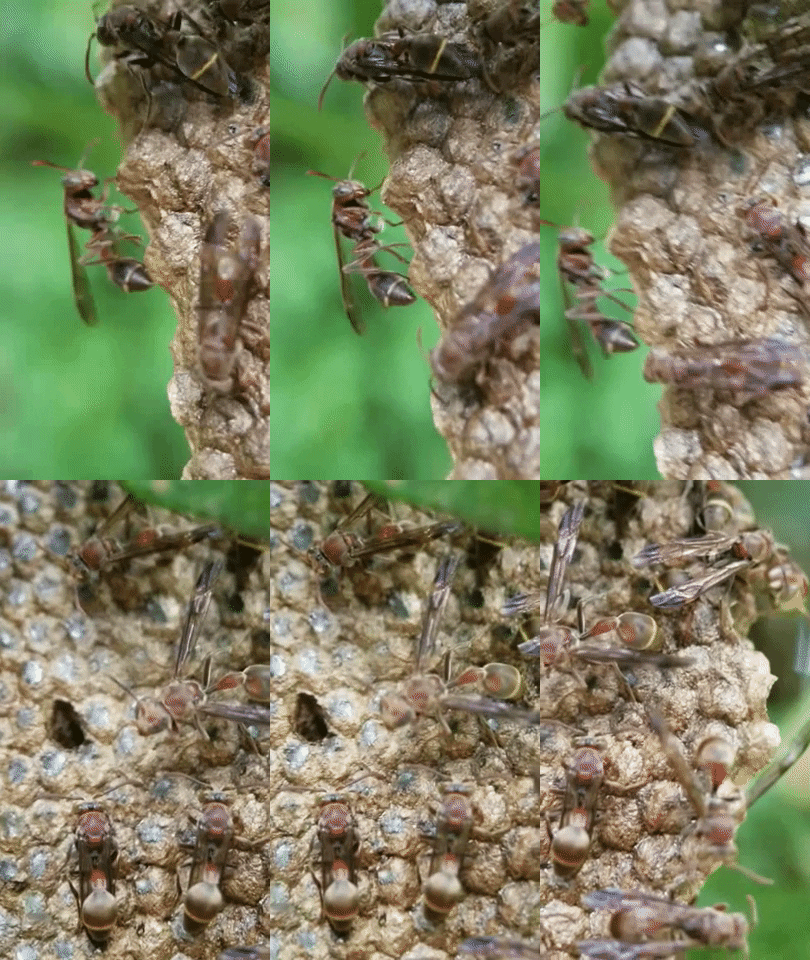
An alternate theory to that of monogamy is the group hypotheses, where the most important condition in the origin of animal eusociality is the formation of groups within a freely mixing population. Groups may be pulled together for various reasons, such as when parents and offspring stay together, or when flocks follow leaders to known feeding grounds, or even randomly by mutual local attraction.

What counts then is the unity and persistence of the group. For example, all of the clades known with primitively eusocial insect species surviving (in aculeate wasps (Figure 1), halictine and xylocopine bees, etc) have familial colonies built around defensible nests.

In rare cases, unrelated individuals will band together to form defensible nests. For example Unrelated colonies of the termite Zootermopsis angusticollis will band together to form a "supercolony" with a single royal pair determined through repeated episodes of combat (Johns et al 2009).

Although family grouping can hasten the spread of eusocial alleles, in contrast to the monogamy theory, it is thought only to be a catalyst not a cause. The prime mover is more likely the advantages provided by a defensible nest - especially one both expensive to make and within reach of adequate food.

In addition to nest construction, pre-adaptations to eusociality have become evident in the Hymenoptera. One is the tendency, documented in solitary bees, to behave like eusocial bees when forced together experimentally (Wcislo 1997). In Ceratinaand Lasioglossum, the coerced partners proceed variously to divide labour in foraging, tunnelling, and guarding the nest. The division of labour appears to be the result of a pre-existing behavioural patterns, in which solitary individuals tend to move from one task to another only after the first is completed. To get to eusocial style labor divisions all we need to see is this behaviour being modified to avoid a job already being done by another colony member.

We'll explore these pre-adaptations and labour divisions in a future post and see how important a role they may play in the evolution of distinct caste systems where workers ultimately forgo reproduction entirely.


References:
Johns, P. M., Howard, K. J., Breisch, N. L., Rivera, A. & Thorne, B. L. Nonrelatives inherit colony resources in a primitive termite, 2009, Proc. Natl Acad. Sci. USA106,1745217456.

Wcislo, W. T. Social interactions and behavioral context in a largely solitary bee, 1997,  Lasioglossum (Dialictus) figueresi (Hymenoptera, Halictidae). Insectes Soc.44,199208. 

Figure:
'Unknown QLD Primitively eusocial wasps right before stinging me', Russell Withers 


Friday, 3 April 2020


It was originally proposed by sociobiologist E. O. Wilson in the 1970s that eusocial communities evolved because they were just one big, happy family. That the  workers didn't care about forgoing reproduction because they and their sisters were so closely related that it didn't matter if she or her sister reproduced. This may be the case, but how did they get to this point?


Figure 1 - Offspring and sibling relatedness with monogamous and polyandrous relationships.
One current theory, the monogamy hypothesis (Boomsma 2007) says that if a female mates with only one individual during her entire life - that is, strict lifetime monogamy - her progeny will be equally related to their siblings and to their own offspring (Figure 1). From here the potential for caste evolution begins to arise as some individuals could opt out of mating to help a dominate reproductive to produce more offspring. Natural selection will favour cooperation in any situation where it is more efficient to raise siblings than offspring, and this could start paving a path towards eusociality.

Researchers led by William Hughes of the University of Leeds in England examined 267 eusocial species of bees, wasps and ants and found that the insects evolved from monogamous conditions, which maximize a group’s degree of relatedness (Hughes 2008). When Hughes's group examined the distribution of monogamous versus polygamous species among the eight branches of the family tree in which eusociality had independently evolved, the researchers concluded that each branch had started with a monogamous species.

In a lot of monogamous species, the death of a partner would mean the individual would start looking for a new mate, which would affect relatedness as family members would be much more related to their offspring than their sibling. This would lower the chances for altruism and ultimately hinder the evolution of eusociality. The death of a partner in a strict lifetime-monogamous relationship obviously presents a large problem in the development in eusocial colonies, and is something that will be covered in a future post. Stay tuned!


References:
Boomsma JJ. Lifetime monogamy and the evolution of eusociality., 2009, Philos Trans R Soc Lond B Biol Sci. 2009;364(1533):3191–3207. doi:10.1098/rstb.2009.0101

Edward O. Wilson, Social Insects, 1971,


Altruism, Spite and Greenbeards, https://science.sciencemag.org/content/327/5971/1341, 29/03/20  

Thursday, 5 March 2020


Due to its relatively recent occurrence, the evolution of human social structure is fairly well understood thanks to the extensive documentation we have in the form of written records and other remnant artifacts. To see how human society evolved before this, we look further back to archeological records or even to extant tribal societies and other closely related primate societies and by doing so we can make a fairly accurate sequence for how we think our societies came about.

Figure 1 - cooperative sister leafcutter ants.
The colonial insects have no such recorded history. Perhaps due to the parallels with our own society it is easy to take for granted the amazing complexity seen in colonial insects, but the evolutionary pathways to reach these complex societies are far less understood.

This means that piecing together the evolutionary timeline is far more difficult, with comparatively little evidence to be found in the archeological records. How these complex societies came about must be inferred, generally by analyzing common traits between social insects and observed behaviors in living insects that have gregarious but non-colonial lives. Colonial insects with a hierarchical social structure have evolved many times in the arthropods, particularly in Hymenoptera (the ants, bees and wasps), as well as in Blattodea (the termites). Common eusocial behavioral characteristics include distinct castes of workers [Figure 1] with well defined divisions of labour, individuals that forgo reproduction (sometimes even sterile), the cooperative care of offspring and the overlap of generations (Wilson 1971).

The evolution of euocialality has presented an interesting conundrum to many an evolutionary biologist. Even Darwin (1859) in his seminal work remarked on the problem of understanding eusociality as 
"one special difficulty, which at first appeared to me insuperable, and actually fatal to the whole theory. I allude to the neuters or sterile females in insect communities: for these neuters often differ widely in instinct and in structure from both the males and fertile females, and yet, from being sterile, they cannot propagate their kind."
Many theories have been proposed for how such complex eusocial societies can arise from solitary organisms. In this blog I aim to explore these theories and discover the various evolutionary stages that were the precursors to true eusocial insect societies.

References:
Darwin, C. On the Origin of Species by Means of Natural Selection. London, UK: John Murray, 1859.

Wilson, E. O. The Insect Societies. Cambridge, MA: Belknap Press of Harvard University Press, 1971.