

 |
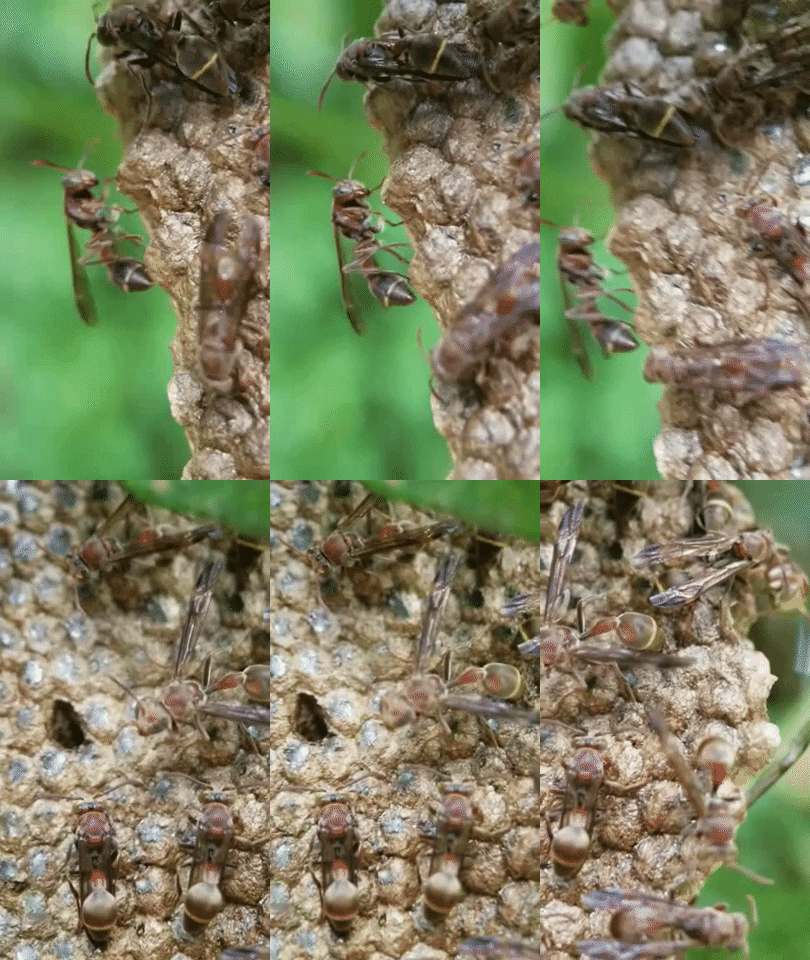
| Figure 1 - 'Pre-eusocial' wasp nest. |
What counts then is the unity and persistence of the group. For example, all of the clades known with primitively eusocial insect species surviving (in aculeate wasps (Figure 1), halictine and xylocopine bees, etc) have familial colonies built around defensible nests.
In rare cases, unrelated individuals will band together to form defensible nests. For example Unrelated colonies of the termite Zootermopsis angusticollis will band together to form a "supercolony" with a single royal pair determined through repeated episodes of combat (Johns et al 2009).
Although family grouping can hasten the spread of eusocial alleles, in contrast to the monogamy theory, it is thought only to be a catalyst not a cause. The prime mover is more likely the advantages provided by a defensible nest - especially one both expensive to make and within reach of adequate food.
In addition to nest construction, pre-adaptations to eusociality have become evident in the Hymenoptera. One is the tendency, documented in solitary bees, to behave like eusocial bees when forced together experimentally (Wcislo 1997). In Ceratinaand Lasioglossum, the coerced partners proceed variously to divide labour in foraging, tunnelling, and guarding the nest. The division of labour appears to be the result of a pre-existing behavioural patterns, in which solitary individuals tend to move from one task to another only after the first is completed. To get to eusocial style labor divisions all we need to see is this behaviour being modified to avoid a job already being done by another colony member.
We'll explore these pre-adaptations and labour divisions in a future post and see how important a role they may play in the evolution of distinct caste systems where workers ultimately forgo reproduction entirely.
References:
Johns, P. M., Howard, K. J., Breisch, N. L., Rivera, A. & Thorne, B. L. Nonrelatives inherit colony resources in a primitive termite, 2009, Proc. Natl Acad. Sci. USA106,17452–17456.
Wcislo, W. T. Social interactions and behavioral context in a largely solitary bee, 1997, Lasioglossum (Dialictus) figueresi (Hymenoptera, Halictidae). Insectes Soc.44,199–208.
Figure:
'Unknown QLD Primitively eusocial wasps right before stinging me', Russell Withers

I’m pretty interested in the notion of pre-adaptations. How would you define these?
ReplyDeleteI guess the idea of pre-adaptations is a bit nebulous as they are adaptations in their own right. They are however adaptations that lend themselves well to eusocial lifestyles with little to no modification, with the species that possess them being 'primed' for evolution towards eusociality.
ReplyDelete